Choosing a product photo editing service sounds straightforward — until you receive your first batch back and half the images have jagged cutouts, color shifts, or backgrounds that do not match your brand. By then, you have already paid, lost time, and may have missed a launch deadline.
Product images are one of the few things you can control on a marketplace listing. They directly affect click-through rate, conversion rate, and return rate. The challenge is not finding a photo editing service — there are hundreds of them. The challenge is knowing which ones deliver consistent, marketplace-ready results at the volume your store needs. This guide breaks down exactly what to look for, what red flags to avoid, and how to make the right call before you commit to any provider.
Image Editing Asia Free Trial: https://imageeditingasia.com/free-trial/
Why Product Photo Editing Matters for E-Commerce Sales
Shoppers cannot touch, hold, or examine your product in person. Your images do all of that work. Clean, consistent, well-edited photos signal professionalism and reduce purchase hesitation. Poor images — blown-out backgrounds, color inconsistencies, harsh cropping — create doubt.
Beyond conversion, platform compliance is non-negotiable. Amazon requires pure white backgrounds (RGB 255, 255, 255) on main product images. Violations get listings suppressed. Other platforms have their own specifications. Professional photo editing ensures every image passes inspection and performs in search results.
What Types of Editing Do E-Commerce Product Photos Actually Need?
Before hiring a service, understand what your product listings require. Most e-commerce photo editing falls into these categories.
Background Removal and White Background Editing
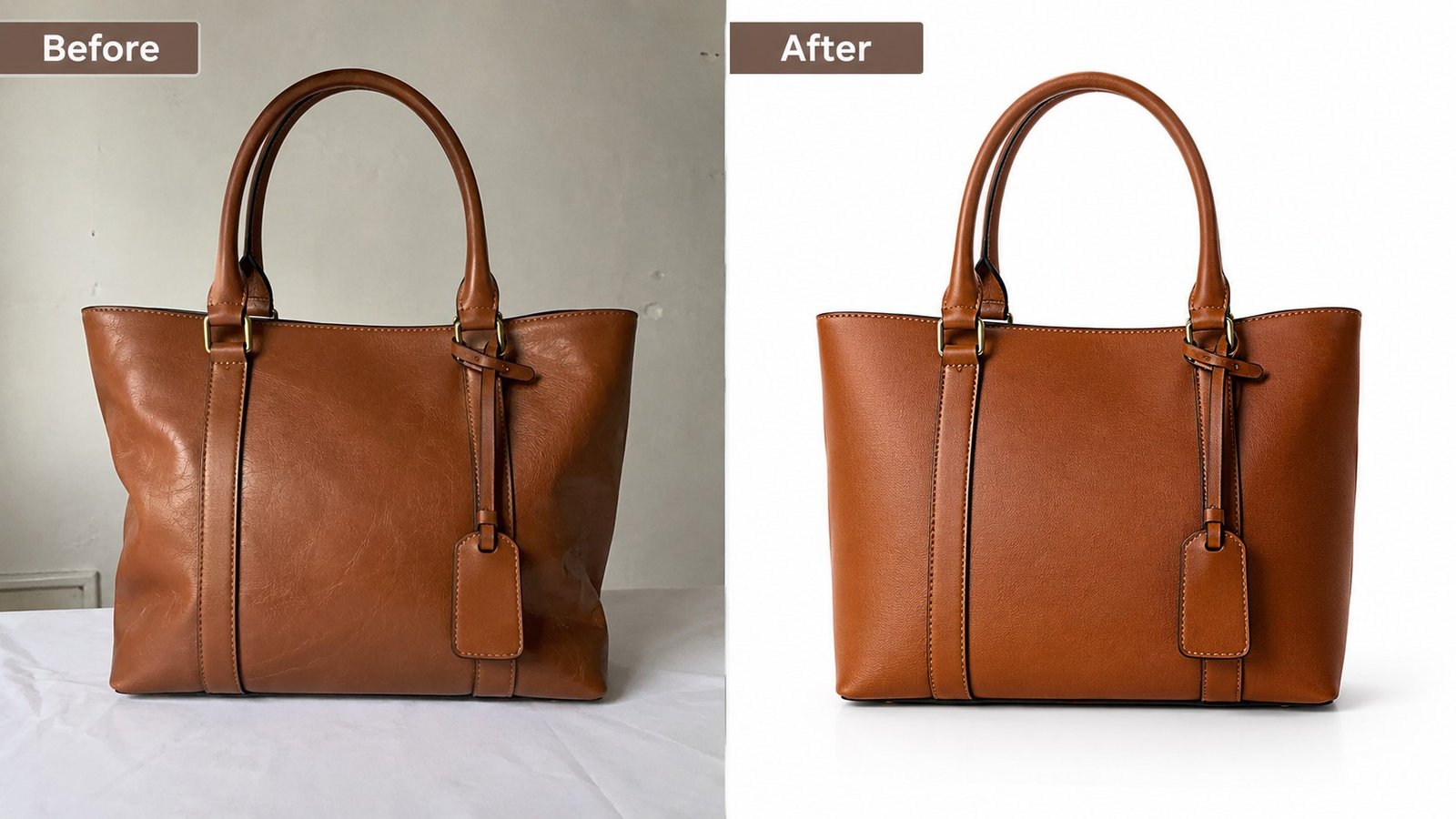
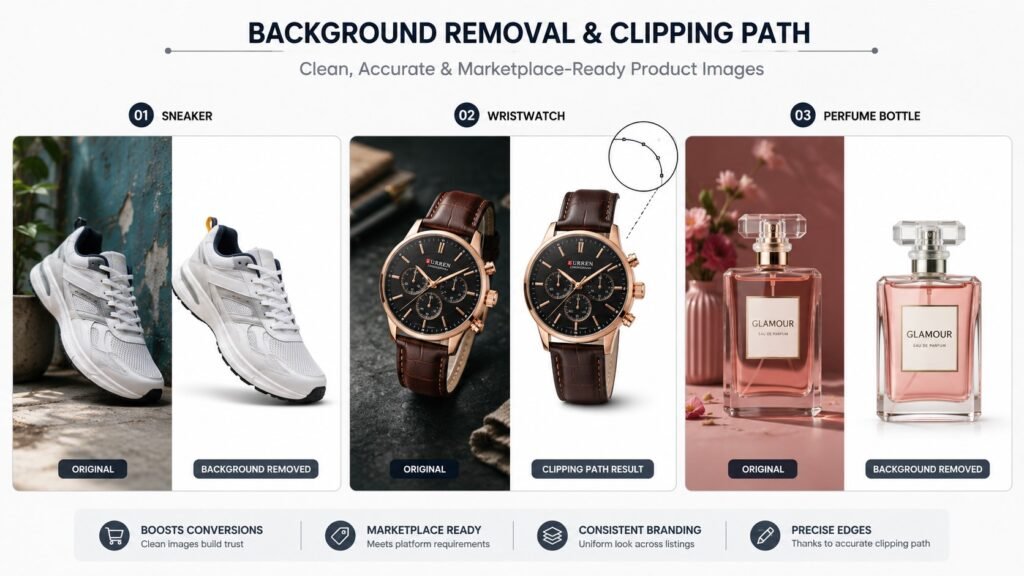
This is the most common service e-commerce sellers need. Removing the original background and replacing it with pure white is mandatory on Amazon and recommended on most other marketplaces. Quality matters here — a poor cutout leaves fringe pixels, unnatural edges, or visible shadows that look unprofessional. A good service produces clean, smooth edges even around fine details like jewelry, hair, or transparent objects.
👉 https://imageeditingasia.com/background-removal-service/
Clipping Path Services
A clipping path is a precise vector outline drawn around a subject to isolate it from its background. It is the foundation of high-quality background removal and essential when images will be used across multiple contexts — packaging, ads, catalogs, or websites with non-white backgrounds. Services vary widely in accuracy, particularly for complex shapes.
👉 https://imageeditingasia.com/clipping-path-services/
Color Correction and Color Consistency
Accurate color is critical for reducing returns. If a red dress looks orange on your listing, customers order expecting one thing and receive another. Color correction adjusts white balance, exposure, and hue to match the actual product. Equally important is color consistency across an entire catalog — all images should look like they were shot and edited under the same conditions.
👉 https://imageeditingasia.com/color-correction-service/
Shadow Creation and Drop Shadows
Shadows add depth and ground the product in the image. Natural shadows (retaining the shadow from the original photo) work well for footwear and some apparel. Drop shadows (added in post) are common for electronics and packaged goods. Ghost shadows give a subtle, soft reflection effect popular in cosmetics and accessories. Ask any service what shadow types they offer and request samples of each.
👉 https://imageeditingasia.com/shadow-creations-service/
Ghost Mannequin and Apparel Editing
Ghost mannequin (or invisible mannequin) editing removes the mannequin from clothing photos to create a hollow, 3D effect that shows the garment’s shape without a model. This is standard for fashion e-commerce and requires skill to look natural. If you sell clothing, this is a non-negotiable capability to confirm before hiring.
👉 https://imageeditingasia.com/ghost-mannequin-service/
Product Retouching
Retouching ranges from light cleanup — removing dust, fingerprints, and minor blemishes from product surfaces — to heavier work like compositing, reflection removal, or fixing packaging creases. Be specific about what you need. Overly heavy retouching can make products look unrealistic, which undermines trust. Good retouching makes the product look its best without misrepresenting it.
👉 https://imageeditingasia.com/retouching-services/
Key Criteria for Choosing the Best Product Photo Editing Service
Evaluating services on price alone is the most common mistake e-commerce sellers make. Here is what actually separates reliable services from unreliable ones.
Image Quality and Consistency
Request samples before committing — specifically samples that match your product type. A service that excels at electronics may struggle with fine jewelry or transparent packaging. More important than individual image quality is consistency across a batch. If 90 images from the same shoot come back looking like they were edited by three different people, that is a problem. Ask for samples of multi-image batches, not just portfolio highlights.
Turnaround Time and Scalability
Standard turnaround for professional photo editing is 24–48 hours for small batches (under 50 images) and 2–4 business days for larger orders. Be skeptical of services promising same-day delivery on bulk orders — speed often comes at the cost of quality or accuracy. More importantly, ask whether the service can scale with you during peak seasons like Q4, product launches, or major promotions. A service that handles your regular volume may not be able to handle 500 images in three days when you need it most.
Revision Policy and Communication
Every service should offer at least one round of revisions at no extra charge. Understand what triggers a revision, how you submit feedback, and what the turnaround is for revised files. Clear communication channels matter as much as the policy itself — a service you cannot reach when something is wrong is a service you cannot rely on.
Pricing Structure and Transparency
Pricing models vary: per-image rates, per-hour rates, and package deals are all common. Per-image pricing is the easiest to predict and compare. Watch for services with unclear pricing pages that require a quote call before revealing costs — this often signals pricing that varies unpredictably. Ask for a full rate card upfront and confirm whether prices change for complex subjects, multiple edits per image, or rush delivery.
File Format and Delivery Options
Confirm the service can deliver files in the formats your workflow requires. JPEG is standard for marketplace listings. PNG preserves transparency for website use. PSD files give you flexibility for future edits. Some services also offer TIFF for high-resolution print use. Check whether they can deliver images sized to platform-specific specifications (Amazon main image: at least 1000px on the longest side for zoom, up to 3000px recommended).
Experience with E-Commerce Platforms
A service familiar with Amazon, Shopify, Etsy, and Walmart Marketplace understands why compliance matters. They know what gets a listing suppressed and how to avoid it. Ask directly whether they have experience editing for the platforms you sell on, and whether they stay current with changing image requirements.
Data Security and Confidentiality
Raw product images — especially for unreleased SKUs — are valuable. Confirm the service has a clear policy on file handling, storage, and deletion after delivery. For sellers launching new products, ask whether they offer NDAs or confidentiality agreements. This is standard practice among professional services.
Red Flags to Avoid When Hiring a Product Photo Editing Service
Some warning signs are easy to spot before you spend any money:
- No portfolio or inconsistent samples — if a service cannot show work that matches your product type, assume they cannot do it well.
- Vague or hidden pricing — legitimate services publish clear rates or provide detailed quotes promptly.
- No revision policy — if it is not written down, it does not exist.
- Unrealistically fast turnaround promises — “100 images in 4 hours” for complex editing is almost always a quality sacrifice.
- Automated or templated customer support — if your first interaction is a chatbot that cannot answer specific questions about your project, your ongoing communication will be worse.
- No clear data security policy — if they cannot explain what happens to your files after delivery, walk away.
Questions to Ask Before You Hire
Before signing up or placing a first order, ask any prospective service these questions:
- Can you share examples of edited images in my specific product category?
- What is your revision policy, and what counts as a revision versus a new request?
- What is your standard turnaround time for orders of my volume?
- Can you scale capacity during peak periods, and do rates change?
- What file formats and specifications do you deliver, and can you match platform-specific requirements?
- How do you handle file security and confidentiality for unreleased products?
A service that answers these clearly and confidently is one you can work with. Vague or deflective answers are signals to keep looking.
How Image Editing Asia Supports E-Commerce Sellers
For e-commerce sellers who need reliable, high-volume product photo editing, Image Editing Asia provides professional editing services tailored to marketplace and catalog requirements. Their services cover background removal, clipping paths, color correction, shadow creation, and ghost mannequin editing — the core edits that product listings depend on.
If you are evaluating providers, visiting their site is a practical starting point. You can review their service offerings and connect with their team to discuss your specific requirements before committing to a full order.
Common Mistakes E-Commerce Sellers Make with Product Photo Editing
Knowing what to do is only half the equation. These are the mistakes that cost sellers time and money:
- Editing in-house without the right tools or skills. Photoshop proficiency does not automatically mean professional-level clipping path or color correction work. Poor in-house editing can be worse than no editing at all.
- Choosing on price alone. The cheapest option almost always has a catch — slower turnaround, lower accuracy, poor communication, or inconsistent results across batches.
- Ignoring platform specifications. Amazon’s image requirements are strict and updated periodically. Editing to generic standards rather than platform-specific ones leads to suppressed listings.
- Skipping a trial order. Placing a large first order with a new service without testing quality on a smaller batch first is an avoidable risk. Most services accommodate trial orders of 10–20 images.
- Failing to maintain visual consistency. As your catalog grows, having images edited by different services — or even different editors within the same service — creates visual inconsistency that damages brand perception.
- Not providing clear editing briefs. Vague instructions produce vague results. The more specific your brief — shadow type, background shade, retouching level, file size, naming convention — the more consistent your output.
Key Takeaways
- Product photo editing directly affects marketplace compliance, click-through rate, and conversion rate.
- The most important editing types for e-commerce are background removal, clipping paths, color correction, shadow creation, and ghost mannequin editing for apparel.
- Evaluate services on image quality consistency, turnaround reliability, revision policy, pricing transparency, platform experience, and data security — not price alone.
- Always test with a small trial batch before committing to bulk orders.
- Maintain a detailed editing brief to ensure consistent results across batches and providers.
Frequently Asked Questions
What is the best product photo editing service for e-commerce in 2026? There is no single answer that fits every seller. The best service for your business depends on your product type, order volume, turnaround needs, and budget. Evaluate providers using consistent criteria: sample quality, revision policy, platform expertise, and scalability. Request samples matching your specific product category before making a decision.
How much does product photo editing cost for e-commerce? Pricing varies widely depending on the complexity of the editing, the service provider, and the volume. Simple background removal may cost less per image than complex clipping path work on reflective or transparent products. Request a full rate card from any service you are considering, and factor in revision and rush delivery costs when comparing options.
How long does product photo editing take? For professional services, standard turnaround is 24–48 hours for small batches and 2–4 business days for larger orders. Turnaround times extend for complex edits — ghost mannequin, multi-layer compositing — or very large volumes. Always confirm turnaround in writing before placing an order, particularly if you are working toward a launch date.
Is outsourcing product photo editing worth it for a small online store? For most sellers, yes — once your catalog reaches 20 or more SKUs or you are updating images regularly, the time cost of in-house editing outweighs the per-image cost of outsourcing. Professional editing also produces consistently better results than most in-house efforts, particularly for background removal and color accuracy.
What file formats should I request from a product photo editing service? For marketplace listings, JPEG is the standard format. Request PNG if you need transparency preserved for website or ad use. PSD files are worth requesting if you anticipate future revisions or want maximum flexibility. Always confirm the service can deliver to the pixel dimensions required by the platforms you sell on.
Conclusion
The right product photo editing service saves you time, protects your marketplace listings, and helps your products look their best across every channel. Getting it wrong costs more than the editing fee — it costs you conversions, listing visibility, and brand credibility.
Focus your evaluation on quality consistency, platform experience, communication, and scalability. Test before you commit. And give your editing partner a clear brief so they can deliver what you need without guesswork.
If you are ready to find a service built for e-commerce volume and quality, visit imageeditingasia.com to explore their services or request a sample edit for your product catalog.
Image Editing Asia Free Trial: https://imageeditingasia.com/free-trial/